Head and neck surgical oncology deals with tumors of the upper aerodigestive tract, the salivary and endocrine glands of the neck, and the skin of the face and scalp. Most malignant tumors of the mouth and throat are squamous cell carcinomas, and their principal causes are tobacco, alcohol and, in the oropharynx, human papillomavirus. Treatment is planned at a multidisciplinary tumor board with radiation oncology, medical oncology, radiology and pathology. Speech and swallowing therapists, dietitians and dentists are involved from the start.
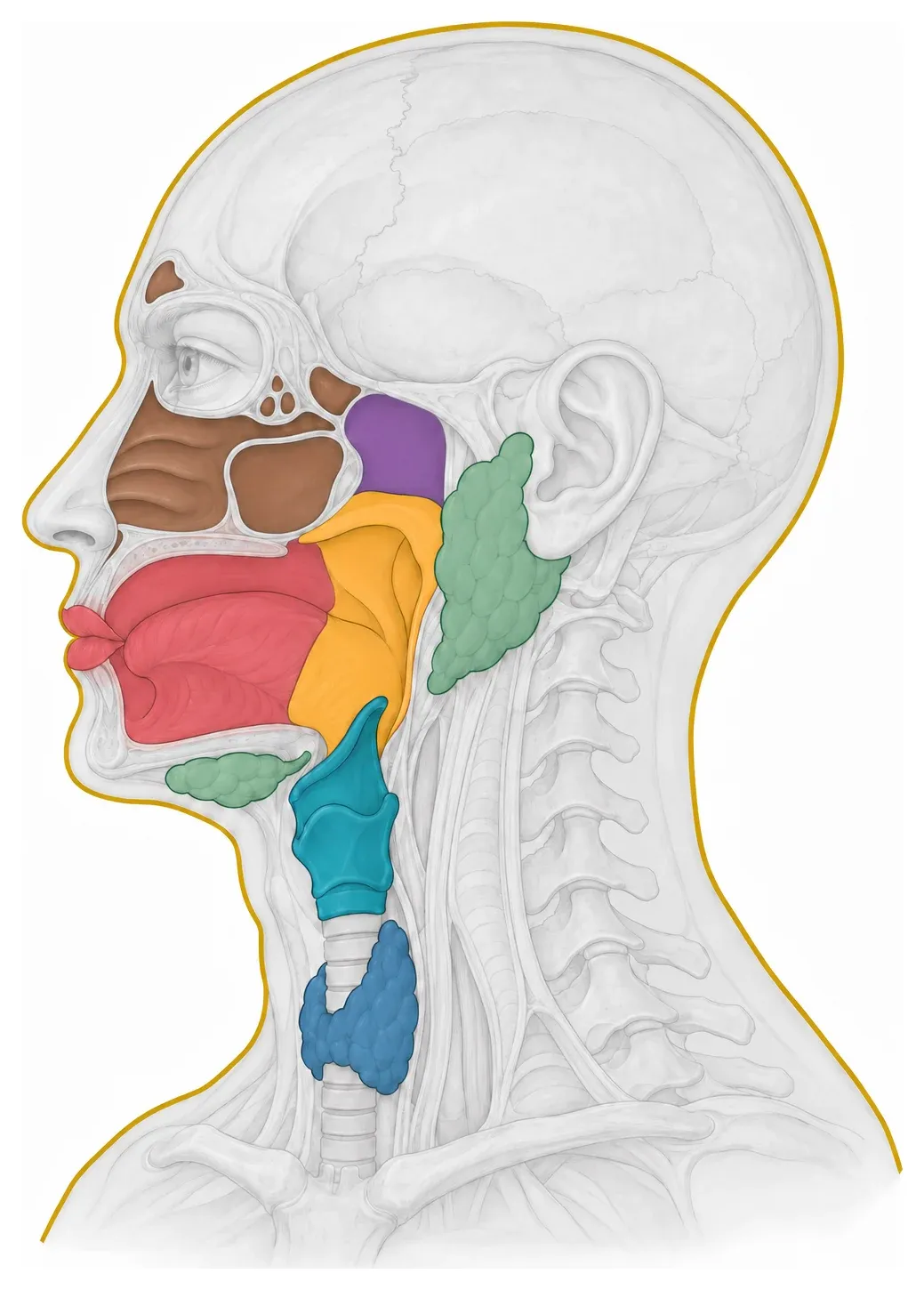
Oral cavity
The oral cavity comprises the lips, the mobile tongue, the floor of mouth, the gingiva, the buccal mucosa, the hard palate and the retromolar trigone. Almost all cancers here are squamous cell carcinomas, and the tongue is the most common site. Surgery is the primary treatment. Early tumors are resected through the mouth with a margin of normal tissue. The cervical lymph nodes are addressed at the same operation, by elective neck dissection or sentinel node biopsy, because occult nodal disease is common even when imaging is normal. Advanced tumors require a wider resection, including a segment of mandible when bone is invaded, with immediate free flap reconstruction and postoperative radiation. Chemotherapy is added to the radiation when the margins are involved or when tumor has extended beyond the capsule of a lymph node.
Oropharynx
The oropharynx comprises the tonsils, the base of tongue, the soft palate and the posterior pharyngeal wall. Cancer here is two distinct diseases. One is caused by human papillomavirus, principally HPV16, and often affects younger patients who have never smoked. The other is related to tobacco and alcohol. The two are staged separately, and HPV-positive disease carries the better prognosis. Early tumors are treated with a single modality, either transoral robotic or laser surgery with neck dissection, or radiation. Advanced tumors are most often treated with concurrent cisplatin and radiation, and some with surgery followed by radiation. Reduced-intensity treatment for HPV-positive disease remains confined to clinical trials.
Larynx
The larynx is divided into the supraglottis, the glottis, which bears the vocal folds, and the subglottis. Most cancers arise in the glottis and cause hoarseness early, which allows diagnosis while the tumor is small. Early cancer is treated with a single modality, either transoral laser microsurgery or radiation, and most patients keep a serviceable voice. A minority require an open partial laryngectomy. Advanced cancer is treated either with concurrent chemotherapy and radiation, with the aim of preserving the larynx, or with total laryngectomy followed by radiation. Surgery is preferred when the tumor has destroyed the laryngeal cartilage or when the larynx no longer functions for breathing and swallowing. After total laryngectomy, speech is restored, most often with a voice prosthesis.
Nasopharynx
Nasopharyngeal carcinoma differs from other head and neck cancers in its cause, its behavior and its treatment. Most tumors carry the Epstein-Barr virus, and viral DNA released by the tumor can be measured in the blood. Because the nasopharynx is hidden behind the nose, the disease is often diagnosed after it has reached the cervical lymph nodes. Radiation is the primary treatment, delivered as intensity-modulated radiotherapy. It is given alone for the earliest stage and with concurrent cisplatin for more advanced disease, often preceded by induction chemotherapy. Surgery is reserved for disease that persists or recurs, either as endoscopic resection of the nasopharynx or as neck dissection.
Thyroid and parathyroid
Thyroid nodules are common and most are benign. Ultrasound and fine-needle aspiration identify those that require surgery. Papillary, follicular and oncocytic carcinomas are grouped as differentiated thyroid cancer and usually grow slowly. Selected papillary carcinomas of one centimeter or less can be followed by active surveillance with serial ultrasound. Otherwise surgery is the primary treatment. Lobectomy is appropriate for low-risk tumors confined to one lobe. Total thyroidectomy is chosen for tumors larger than four centimeters, bilateral disease, extension beyond the thyroid or metastasis, with central or lateral neck dissection when lymph nodes are involved. Radioactive iodine is given after total thyroidectomy according to risk and is not needed in low-risk disease. Medullary carcinoma is treated with total thyroidectomy and central neck dissection. Anaplastic carcinoma requires urgent assessment and molecular testing. Primary hyperparathyroidism is treated by removal of the overactive gland or glands.
Salivary glands
Most tumors of the parotid gland are benign, the most common being the pleomorphic adenoma and the Warthin tumor. The smaller the gland, the higher the probability that a tumor in it is malignant. Pleomorphic adenomas are removed because they continue to grow and can undergo malignant transformation. Salivary cancers are rare and histologically diverse. They include mucoepidermoid, adenoid cystic, acinic cell and salivary duct carcinomas, and the grade matters as much as the type. Surgery is the primary treatment, by parotidectomy with identification and preservation of the facial nerve under monitoring, or by excision of the submandibular gland. When the nerve is invaded, the involved segment is resected and repaired with a nerve graft during the same operation. Neck dissection and postoperative radiation are added for high-grade or advanced tumors, involved margins, perineural invasion or nodal disease.
Nasal cavity and paranasal sinuses
Sinonasal tumors are uncommon and histologically diverse. Many can be resected endoscopically through the nose. Others require an open approach, sometimes with reconstruction of the palate, the orbit or the skull base.
Skin of the head and neck
Advanced basal cell carcinoma, squamous cell carcinoma and melanoma of the face, scalp and ear may require wide excision, with parotidectomy or neck dissection when the regional lymph nodes are involved, and reconstruction with local flaps or free tissue transfer.